

Performance Management | Fixing Underperformance Strategically
Underperformance persists when leaders react emotionally or avoid diagnosis, allowing systemic misalignment to become a cultural liability.
Most organisations do not struggle with identifying underperformance. They struggle with addressing it.
Underperformance lingers quietly. Standards soften. Conversations are postponed. Documentation begins only when frustration peaks. By then, the problem is no longer performance, it has become a culture.

The Cost of Avoidance
Unresolved underperformance creates ripple effects:
High performers disengage
Team morale declines
Leaders lose credibility
Standards become negotiable
Customers feel the impact
Avoidance may feel kind in the moment. But it is expensive over time.
Expert Insight
“The ultimate reason for setting goals is to entice people to become the best version of themselves.” — Jim Rohn
Underperformance should not immediately trigger punishment. It should trigger a diagnosis. Performance breakdown is rarely random. It is usually rooted in one of three causes:
Misalignment
Capability gaps
Behavioural resistance
Without diagnosis, leaders default to discipline or avoidance. Neither solves the problem.
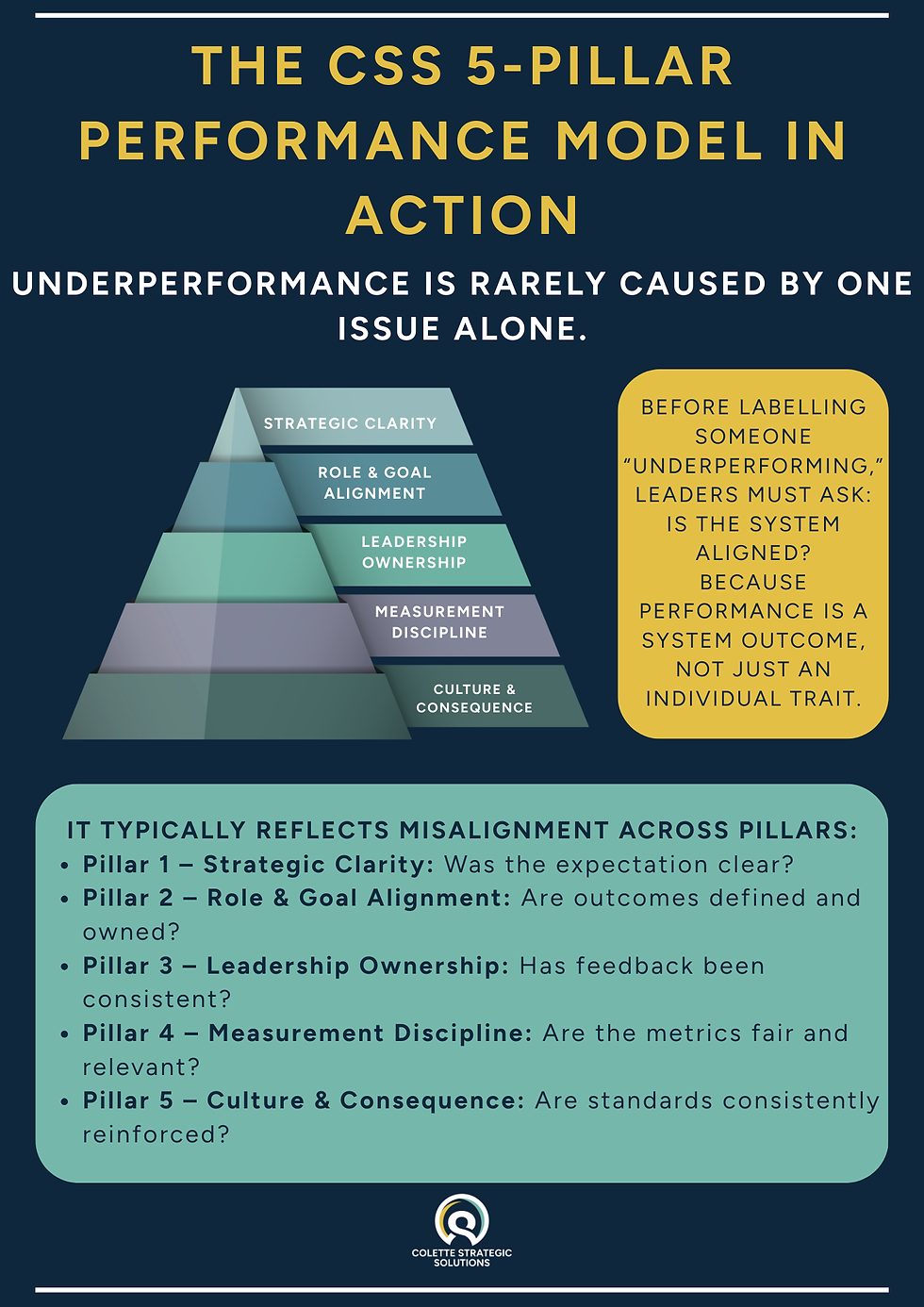
The CSS 5-Pillar Performance Model in Action
Underperformance is rarely caused by one issue alone.
It typically reflects misalignment across pillars:
Pillar 1 – Strategic Clarity: Was the expectation clear?
Pillar 2 – Role & Goal Alignment: Are outcomes defined and owned?
Pillar 3 – Leadership Ownership: Has feedback been consistent?
Pillar 4 – Measurement Discipline: Are the metrics fair and relevant?
Pillar 5 – Culture & Consequence: Are standards consistently reinforced?
Before labelling someone “underperforming,” leaders must ask: Is the system aligned? Because performance is a system outcome, not just an individual trait.

The Strategic Diagnosis Model
When performance falls short, assess three dimensions:
Clarity
Does the individual fully understand expectations, outcomes and standards? If not, correct alignment first.
Capability
Does the individual have the skills, tools, or resources required? If not, develop capability.
Commitment
Is there a behavioural or motivational gap? If yes, structured consequence becomes necessary.
Clarity without capability creates frustration. Capability without commitment creates inconsistency. Commitment without clarity creates confusion. Diagnosis determines response.
Four Strategic Shifts in Addressing Underperformance
Act Early
Do not wait for annual reviews. Address small gaps before they widen.
Separate Emotion from Process
Use structured frameworks. Avoid reactive escalation.
Document Progress, Not Just Failure
Improvement efforts should be visible and measurable.
Protect High Performers
Inconsistent accountability damages culture faster than poor results.
The Leadership Question
If a high performer in your team observed how underperformance is handled, would they feel confident in your leadership? Or frustrated? High performers watch how standards are enforced. Culture is revealed in those moments.
Final Thought
Fixing underperformance is not about being harsh. It is about being fair. Strategic organisations diagnose before disciplining. They clarify before correcting. They support before escalating. But they do not ignore. Because when underperformance is left unresolved, culture absorbs the cost.
Diagnose clarity, capability and commitment gaps before applying corrective action.
To support this stage of the CSS 5-Pillar Performance Model, download the CSS Underperformance Diagnostic Tool.
This structured guide will help you:
Diagnose clarity, capability and commitment gaps
Choose the right leadership response
Apply improvement plans consistently
Protect performance standards
Because underperformance is not solved by avoidance. It is solved by alignment and action.



Comments